
Kodiak CEO says making trucks drive themselves is only half the battle
This year marks significant advancements in the realm of autonomous trucking, with major players such as Aurora planning to deploy hundreds of driverless big rigs and Waabi expanding their reach into robotaxis. Amid these developments, Kodiak AI is preparing to launch its own fully autonomous long-haul freight operations by the close of 2026. While robotaxis continue to dominate headlines, the progress of driverless trucks is quietly but steadily accelerating.
Kodiak AI’s CEO, Don Burnette, emphasizes that achieving autonomous driving capability is only part of the challenge. According to him, while many competitors focus on artificial intelligence, perception systems, and mileage statistics, Kodiak is concentrating on the operational realities of running a business. Critical questions such as truck ownership, expected uptime, and the nature of the cargo being transported are central to their strategy. Burnette highlights that beyond ensuring safe operation on roads—which he calls a basic expectation—the true value to customers lies in maximizing efficiency and effectiveness throughout the entire process of integrating trucks in and out of their operations, a topic often overlooked by others.
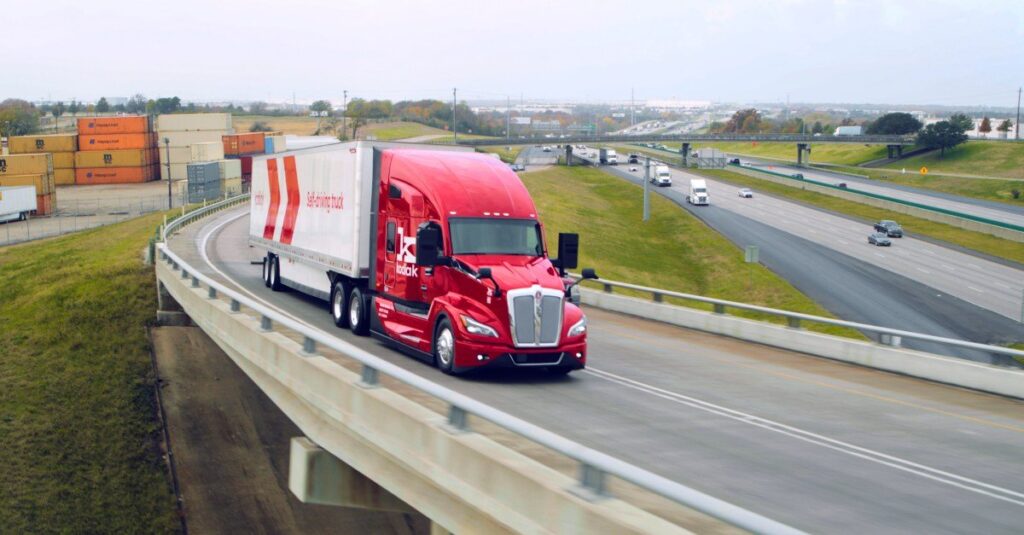
Kodiak AI, originally Kodiak Robotics and founded in 2018 by Burnette and Paz Eshel, is engaged in developing self-driving trucks for highway, industrial, and defense sectors. Since 2025, its trucks have performed driverless deliveries in the oil-rich Permian Basin region, operating a fleet of 20 such trucks. The company entered the public market through a reverse SPAC merger in September 2025.
Looking ahead, Burnette notes that Kodiak is active across various sectors, particularly focusing on complex, unstructured environments typical of industrial and off-road trucking—a domain he believes offers significant opportunities compared to traditional on-road autonomy. By mastering these unpredictable settings, their trucks become better prepared for more regulated environments like highways. Burnette confidently states their goal to operate entirely driverless trucks by year-end, believing that the product’s value materializes only when no human driver is needed.
A critical step before this involves completing a comprehensive safety case that encompasses vast data collection, virtual simulated driving, and meticulous risk mitigation planning. Burnette credits Waymo’s rigorous safety culture as influential in shaping Kodiak’s stringent safety protocols.
Kodiak adopts a distinct business model compared to other autonomous vehicle companies. Rather than depending on original equipment manufacturers to supply autonomous-ready trucks, Kodiak develops aftermarket solutions with partners such as Roush Industries and Bosch, enabling production of fully compliant, automotive-grade vehicles and facilitating scalability when technology readiness peaks. Presently, Kodiak’s 20 delivered trucks are owned and operated by its customers, not the company itself.
This ownership model differentiates Kodiak substantially from its competitors, including Waymo. Burnette explains that customers who own the vehicles prioritize metrics like utilization, operational uptime, maintenance demands, and revenue generation continuously, demanding far higher reliability and performance standards. He argues that trucks must consistently function effectively to be marketable to customers.
Conversely, when autonomous vehicle developers own and control their trucks, deployments can be curated without stringent requirements for real-world functionality. Burnette points out that some rivals’ fleets may operate only sporadically, yet still claim success as “driverless,” an approach he criticizes as unrealistic for delivering a genuine product to customers.
Burnette does not shy away from outspoken critiques of competitors, especially regarding expansion into robotaxi markets. He questions whether competitors had fully-fledged products prior to entering new domains, asserting that Kodiak is leading in real-world implementation and operational discipline. He perceives many others as focusing heavily on flashy technology demonstrations and visuals, neglecting the more challenging task of delivering usable, customer-owned autonomous solutions.
He stresses that most companies have yet to address what he terms the third pillar of autonomy: making the technology truly practical within actual workflows. This includes integrating autonomous trucks seamlessly into customer operations, managing the complexities associated with pickups and dropoffs, and providing robust monitoring and communication capabilities. While peers concentrate mostly on driving ability, Kodiak AI is advancing both driving performance and full-system integration. Burnette highlights that this critical aspect of the autonomous trucking industry remains largely unacknowledged by others.
