
Director’s View
The Copper Line
In 2017 I decided to surprise Kim with three weeks in Botswana and the Okavango Delta, and because I once went to flight school, I planned it on a spreadsheet. Every campsite had a date and a distance from the one before, and the nearest fuel stop to each was worked out so that we could carry as few emergency jerry cans as possible. Some cells carried notes. “River not crossable in rainy season.” “Stop here to ask for directions.” I prepaid Chobe’s sought-after campsites through SKL Camps in Maun at about R1,000 a night, non-refundable.
It was only Kim’s second major overlanding trip, so I split the drive, with the first night at Tankwa Tented Camp on the R355, midway between Ceres and Calvinia in the Tankwa Karoo. We travelled in The Monster, our Defender 110 Td5. She had opinions of her own. None of them were in the spreadsheet.
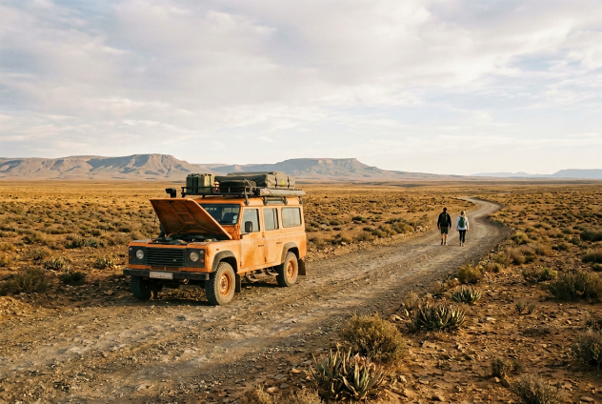
Day two found us about 60km south of Calvinia on the Easter long weekend, and nobody takes that road on a long weekend, because sane people go round on the tar through Nieuwoudtville. There was no signal. I was giving The Monster stick when she made her position clear. “I have read your spreadsheet,” she said, more or less, “and I am not in it.” We went from cruising in fifth gear to having no gears at all.
Kim glanced at me. “JD,” she began.
“I think I saw an old farmhouse about three kilometres back,” I said, before she could get any further. At work I make a practice of consulting the frontline staff, because they are often the first to know when something is wrong with a customer. On the R355 the frontline was sitting next to me, and I did not let her finish a sentence.
Dis jy
We walked. The farmer was home, with his two adult sons, and his land was used every year for the Tankwa Rally. When Kim and I walked onto his farm, he said the words I will never forget: “First Technology, Johan de Villiers, dis jy. Dis jy!” It’s you.
He had not forgotten the hay. During the drought of 2015 and 2016, the Tankwa Rally’s organisers told me that the farmers who let the rally race across their land had run out of food for their Angora sheep. First Technology contributed to a feeding scheme, and hay bales went up to the Northern Cape on 28-wheeler trucks. Of all the farmhouses in the Tankwa, his was the one I had walked to. I would love to call that strategy. It was hay.
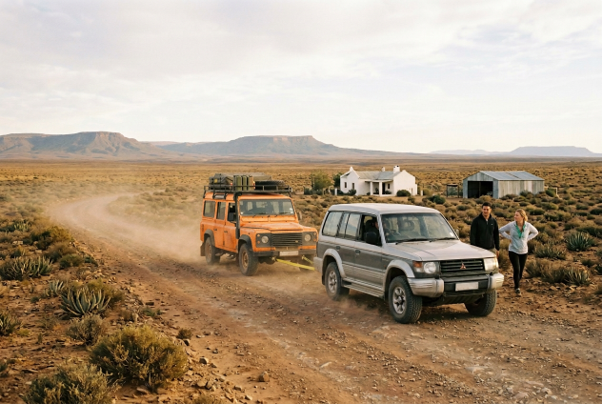
He and his sons towed The Monster to the workshop on the farm with his Pajero. Being towed by a Pajero is a humbling experience for a Defender man. I have never been so glad to be humbled. The gearbox was beyond repair. It was Easter, and the nearest towing service was six hours away in Laingsburg. There was no signal on the farm either. There was something better: an old but working ADSL connection on a copper line, a proper boerelyn, a farmer’s telephone line, and over it you could make a Wi-Fi call.
A son on a date
The next call was to my son Ryan, then 22. “Ryan,” I said, “Dad’s three-week trip has come to an epic halt after twenty-four hours. I need you to come and fetch us.”
“Dad,” said Ryan, “I’m on a date.” If I had Wi-Fi, he reasoned, it could hardly be an emergency. Then he ended the call. I stared at the phone and briefly considered changes to my will. In fairness, I think I would have done the same, and I am glad he has his priorities right.
So we waited for the flatbed with the farmer and his sons, who taught us to shoot every hunting rifle with a scope that they had and served us a lavish lunch. The flatbed arrived at 7pm, and the next day I was back at the office, having taken the shortest three-week holiday anyone there had ever seen me take.
Ryan had given me, free of charge, the two ideas at the heart of Ray Dalio’s management philosophy at Bridgewater Associates. Dalio calls them radical truth and radical transparency. The first asks people to speak their minds openly and confront problems directly, without fear of retribution. The second asks that information be shared freely, including where things have gone wrong. Neither is a licence for rudeness, and Ryan stayed on the right side of that line. He was accurate, and then he hung up.
The test of a culture like that is not whether somebody tells you the truth. Somebody always does, usually the person with the least to lose. The test is what happens to them next. My first instinct was to change my will. Most companies have the same instinct, and a performance review to act on it with.
The copper line
Dalio credits Bridgewater’s success to a culture he calls an idea meritocracy, in which the best idea wins regardless of the rank of whoever had it. He refines it with believability-weighted decision-making: each person’s opinion is weighted by their track record and expertise in the subject at hand.
In the Tankwa that Easter, believability was not evenly spread. I had a spreadsheet and a company. The farmer had a Pajero, a workshop, two sons, a working line to the outside world and the final word on my gearbox. On his land, my name bought me a warm welcome. It did not buy me a vote.
A title is the badge on the bonnet. It tells you who made the vehicle, not whether the gearbox will hold. Believability weighting has proved most useful to me in business when a decision cannot wait. A junior engineer with a history of successful projects should carry more weight on engineering matters, whatever their rank, and on what customers are unhappy about, the frontline staff often carry more believability weight than their desks would suggest, because they hear it first.
In an IT department, the copper line is usually the service desk: the people who hear about the slow system and the failing backup before any dashboard does, and who are seldom asked before the project plan is signed off.
Call it the boerelyn rule. Every company has an old copper line somewhere: a person nobody thinks to consult because they are not senior enough, who still has a signal when the expensive network has none. Find out who it is before the long weekend, not during it.
Where the machine breaks down
Now for the part that flatters neither me nor Dalio. He argues that life’s complexities can be broken down into rules and understood the way you would understand a machine. The machine that mattered that Easter was a gearbox, and no rule of mine saw it coming. What rescued us was a farmer who had not forgotten some hay, and luck chose his farmhouse. A good name can earn you a rescue. It cannot choose where you break down.
Radical truth is charming from a son on a date. From a junior in a client meeting, delivered with the same timing, it can cost you the client. Insisting that it must never become rudeness puts the whole weight on judgement, and judgement is exactly what a principle is supposed to spare you.
And the concession I mind most: I have spent most of this piece admiring people who tell the truth, and when Kim tried to tell me something on the R355, I talked over her. The man with the spreadsheet had planned for everything except listening.
Who should ask the farmer, and who should not bother
Ask the farmer if your plans are better than your information: if the project plan is immaculate and the last person who told you something unwelcome was quietly moved sideways for it. Ask him if your service desk hears about a problem before your board does. Weigh each opinion by who has fixed this kind of thing before, and let the junior with the record outrank the senior with the title on the question in front of you.
Do not bother if you want radical truth as a poster in the canteen, running from the top down and never back up, or if you would change your will the day the honest answer arrives. And do not bother if, like me on the R355, you answer “JD” with a plan before you have heard the rest of the sentence.
The best cell in that spreadsheet was a note: stop here to ask for directions. It was good advice. I had simply typed it into the wrong row. The right row was 60km south of Calvinia, three kilometres back up the R355, at a farmhouse with a copper line and a farmer who already knew my name.
Johan de Villiers,
CEO,
First Technology Western Cape
