
Director’s View
Minus thirty on Elbrus
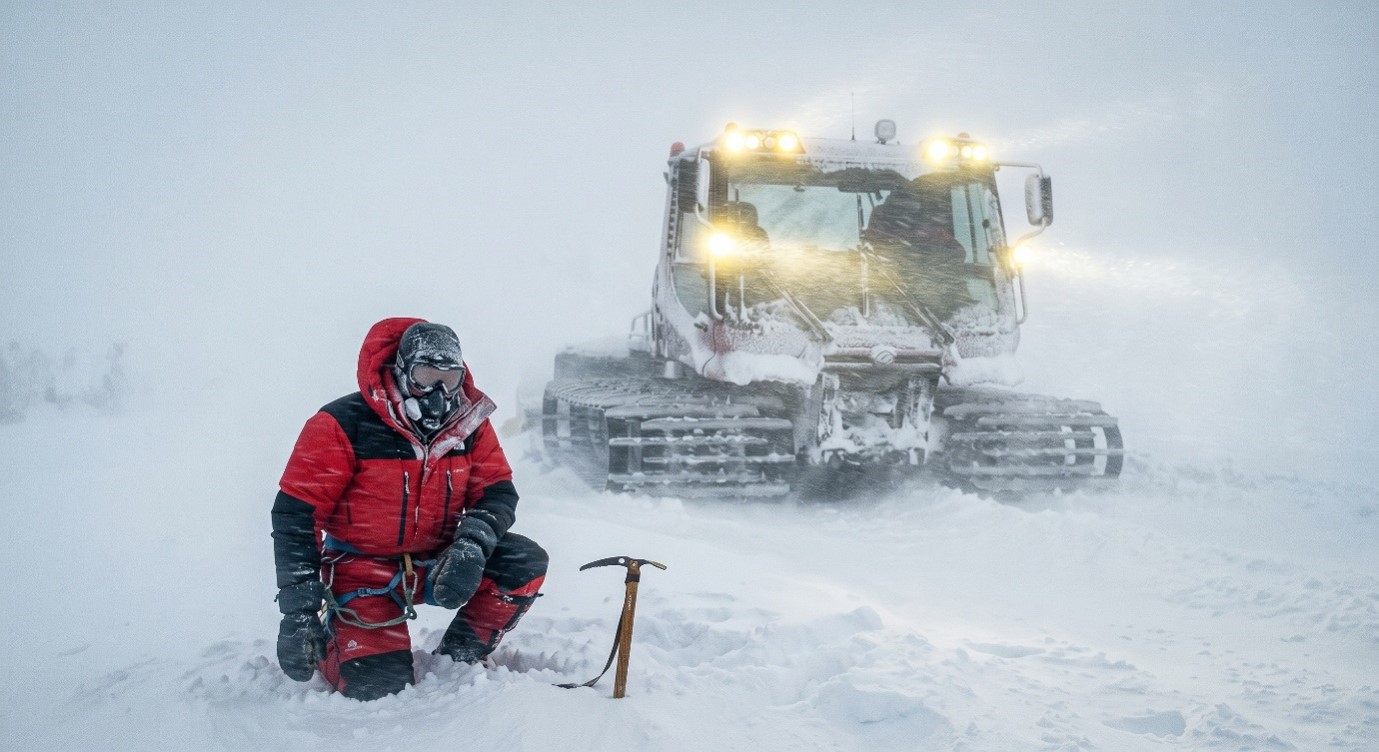
At four in the afternoon on Mount Elbrus, on a flat piece of ground I could no longer see, Kim said the thing you never want to hear at altitude. “I can’t feel my hand.” Her ice axe was already lying at her feet, which told me more than the sentence did.
We were coming down off an acclimatisation climb above the Barrels Huts, our base camp at 3,750 metres. The satellite forecast for the following eighteen to twenty-four hours had promised nothing worse than minus six. We were standing in minus thirty, in 55-knot wind, in a whiteout that had removed the difference between the ground and the sky. It was midsummer.
Vlad had a working cell phone. We got in behind a rocky outcrop and called the Russian base station, and they said they would come, and then they quoted a price that made my eyes water, payable before the vehicle left the base. I have heard people tell that as a scandal. It was not. An hour later a Snowcat came up through the murk on nothing but pre-plotted GPS coordinates, and I would gladly have paid ten times the asking amount.
That is the whole argument of this newsletter. I will come back to it.
What came down the Bhote Koshi
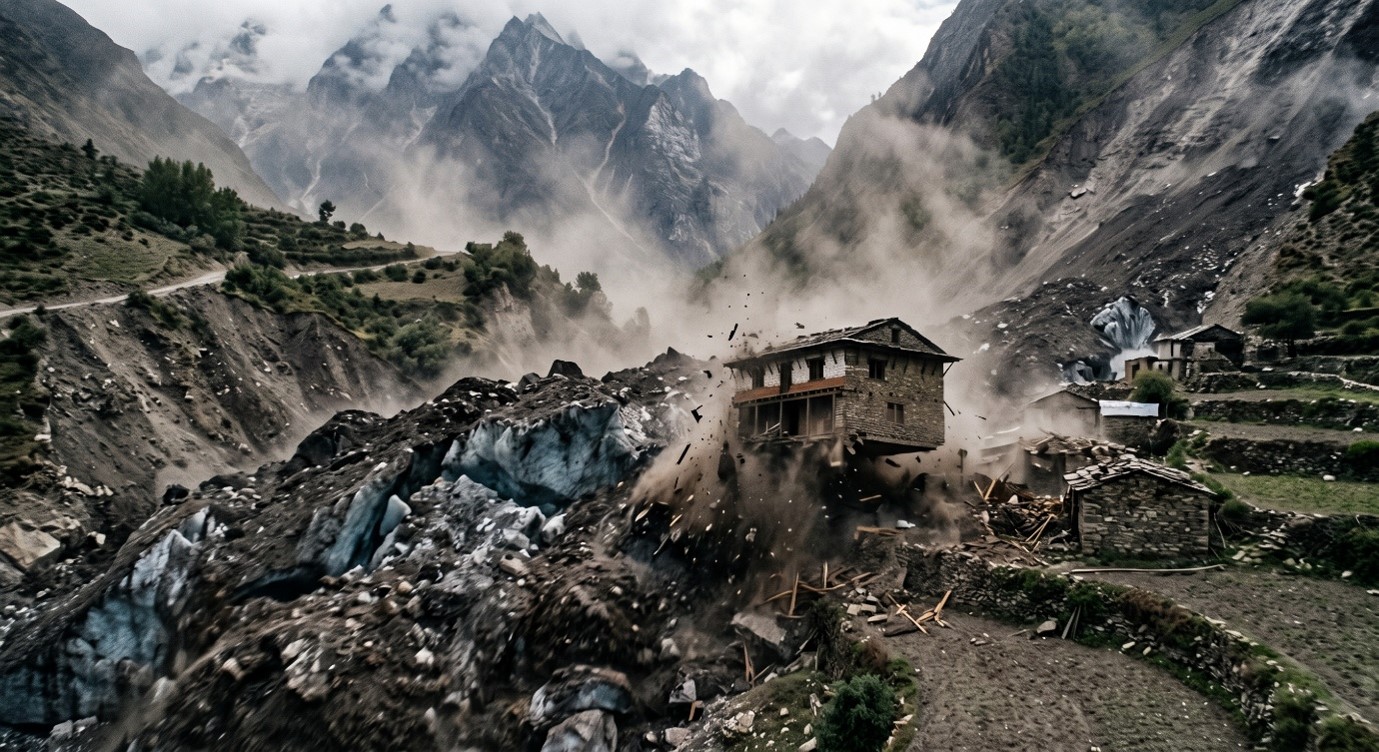
Last Wednesday, 26 August, a large section of cliff north of Langtang Lirung, close to the Tibetan border, gave way and snapped off the chunk of glacier sitting on top of it.
The seismographs read it as an earthquake. The United States Geological Survey first logged a magnitude 4.4 tremor near the border and later revised it to a magnitude 5.2 landslide, noting that the energy had been generated by a glacial collapse and debris flow. Simon Cook at the University of Dundee put the fall of the glacier’s lower hanging terminus at about 1,300 metres into the valley beneath it. Simon Allen at the University of Zurich, working back from the seismic signature, put the debris at 50 to 100 million cubic metres. His word for it was massive, and he added that it was bigger than any event of its type seen in the region in historical times.
What arrived in Rasuwa district was not a flood in any sense a South African would recognise. It was a hillside in motion. A truck driver named Giri Lal Budhathoki described his house being lifted several metres into the air before it collapsed, and said he was preparing to mourn a wife and four children who had not been found.
By Friday the count stood above 469 dead and 1,400 missing. By Sunday it was 788 dead and 2,502 missing in Nepal, with a further 16 dead and 546 missing on the Chinese side. Nepal had almost 20,000 security personnel in the valley and had pulled out more than 9,400 people, 279 of them trapped inside hydropower projects.
The third test is the one that catches boards
Nassim Taleb’s test for a black swan has three parts. The event has to sit outside anything the historical record prepared you for. It has to hit hard. And afterwards it has to look obvious.
The third part is where the damage gets done in a boardroom, because it is not a property of the event at all. It is a property of us. Once we know the answer we cannot un-know it, and the signal that was noise on Tuesday reads as a warning on Thursday. Every risk register I have ever sat in front of has a column for likelihood, and every one of those columns was filled in by people who had already read the news.
The class was known, the instance was not
What was genuinely foreseeable here is a great deal more than most people assume.
The Himalaya are warming faster than the global average. Anil Kulkarni at the Indian Institute of Science in Bengaluru puts the mechanism plainly: the permafrost binding ice mass to rock has started to weaken. In 2021 a mass of rock, snow and ice came off a mountain into the Rishi Ganga valley in India and killed more than two hundred people, which showed the scientific community exactly how destructive a glacier fall could be. The World Bank and the Asian Development Bank warned in that same year that Nepal’s topography and social vulnerability left it particularly exposed to this. And Kulkarni’s own summary of the scale is the line that belongs above every risk register in the region: there will be thousands of such hanging glaciers in the mountains.
So the class of event was known, published, quantified and warned about in advance. What nobody had was a name and a grid reference.
A hanging glacier announces nothing. She has been sitting on that cliff since long before anyone thought to look at her, in no hurry, indistinguishable from several thousand others doing nothing at all on several thousand other cliffs. If she had a view on the matter she would give you the same answer the mountain always gives. “I have no schedule and I am not aiming at anybody. I am simply heavier than the rock underneath me, and one day that will matter.”
That is a roof in a gale. You know with total confidence the roof will lose tiles. You cannot say which one, and the correct response was never to identify the tile. It was to stop standing underneath.
The rule I took off Elbrus and have not broken since is this. Buy the rescue while it still looks expensive. The only day a safeguard is priced fairly is a day you resent paying for it.
Where my own argument is weak
The hindsight I am selling has a hole in it, and the people who study this for a living put a finger straight on it. Simon Cook again, on early warning systems: picking out the glaciers that might collapse is like looking for a needle in a haystack, because they look like every other glacier and it is genuinely hard to say which ones are dangerous. Allen’s point that this was larger than anything of its type in the historical record does the same damage to my case. You cannot claim to have budgeted for an outlier by naming it an outlier afterwards.
I am also in no position to lecture anyone about ignored warnings. On that same expedition we had a six-day summit window and lost five days of it to snow. On the last morning our guides did not know whether the fixed lines were still intact, what the conditions were at the top, or whether the ascent was safe at all. We went anyway. Not because we had assessed anything. Because the window was closing, we had come a long way, and there would not be another chance that year. I have watched boards make that exact call on a launch date. I have made it myself. It is the same decision wearing a suit.
Ten hours up, a gust took a climber a hundred metres ahead of us and threw him off the mountain. He rolled nearly a thousand metres. We watched it happen from the slope, and then we carried on climbing, because we had already decided.
Who should act on this, and who should not bother
Act on it if your business carries a failure you have priced as unlikely rather than as survivable. A sole supplier. One person holding a client relationship nobody else in the building has ever been introduced to. Those Nepali hydropower sites had people inside them when the valley filled, and they sit where they sit because that is where the water is. The exposure was structural, not bad luck. If you can draw your business on one page and there is a single line that ends the story when it is cut, that line is your hanging glacier, and the useful question is not how likely it is to go. It is what you would pay on the morning it went.
Do not bother if what you want out of this is a longer risk register. Adding rows is filing, not mitigation. And do not bother if the plan is a workshop on unforeseeable events, because a workshop will produce a list of foreseeable ones and everybody will leave feeling better. The real work is smaller and duller than that. Name the two or three failures you could not trade through, and go and find out this week what the fix actually costs.
I still think about the number those Russians quoted us. It was outrageous at base camp, in a warm metal barrel with a book on my lap, working out what a mountain rescue ought to cost. It was the cheapest figure I have ever been given an hour later, standing in a whiteout beside a woman who could not feel her hand, watching a set of yellow lights come up through the snow on coordinates alone. Nothing about the number had changed. We had.
Johan de Villiers,
CEO,
First Technology Western Cape
