
Nvidia’s AI advantage is moving beyond the GPU
Before this week, the prevailing narrative surrounding Nvidia was fairly straightforward: during the initial surge of the AI boom, Nvidia stood as the sole provider of cutting-edge GPUs, which grew highly lucrative as the sector expanded. However, in recent years, major cloud providers like Amazon and Google began producing their own semiconductor chips, challenging Nvidia’s exclusive grip and prompting investors to question the longevity of its dominance. This account largely holds true. Nvidia’s market capitalization surged tenfold between early 2023 and mid-2025, but over the past year, its stock performance has tempered, reflecting concerns over increasing GPU competition.
Post its latest earnings report, a fresh perspective on Nvidia has emerged, revealing that its competitive edge extends far beyond GPUs alone. As AI workloads push compute power into the gigawatt range, managing these vast resources has grown significantly more complex. Nvidia has developed many advanced hardware components essential for orchestrating AI systems efficiently, giving it a substantial advantage in system-level integration, even as it faces greater rivalry on the GPU front. Although compute power is often treated as a commodity, operating large-scale data centers at maximum efficiency remains an exceptionally challenging task—one that only intensifies with escalating deployment sizes and speeds.
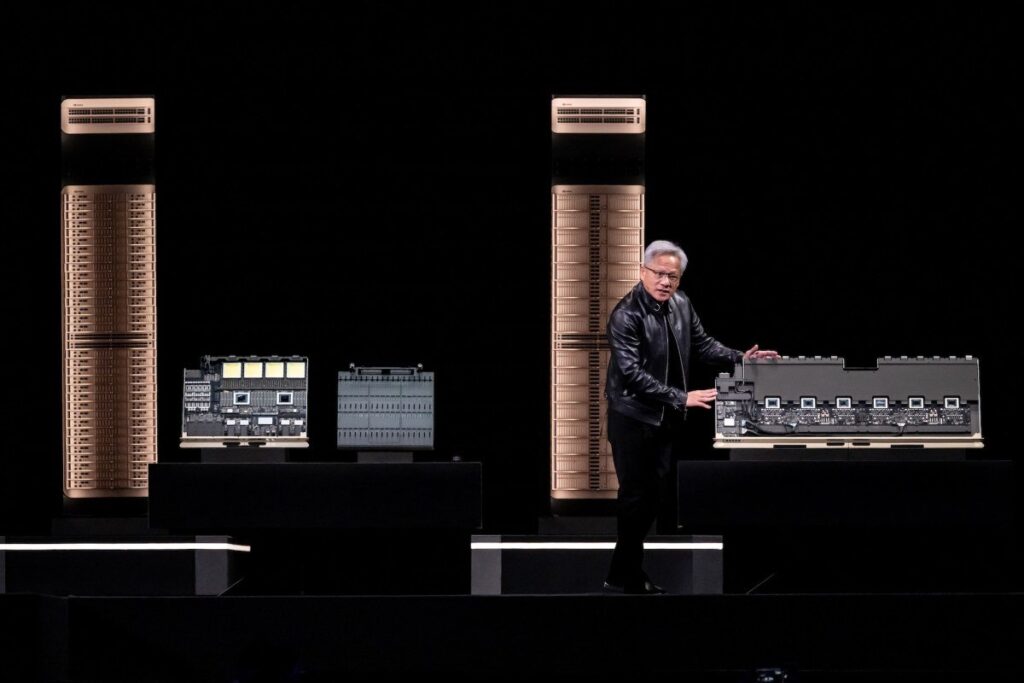
Examining Nvidia’s product lineup offers insight into this complexity. The company is rolling out its Vera Rubin architecture, which combines the Rubin GPU with various specialized units such as the Vera CPU and the Groq 3 LPX inference accelerator, alongside dedicated racks for storage and networking. Conversations with Nvidia insiders over the past week revealed that these systems are meticulously designed not just to process AI tasks on GPUs but to optimize every aspect surrounding the GPU’s operation. In analogy, if the GPU is the engine, these components function as the critical supporting parts of the vehicle.
The Vera CPU, in particular, is tasked with efficiently orchestrating data flow. As Nvidia’s VP of storage technology explained, the limitation on memory capacity within individual servers or compute platforms drives the need for effective data management. While memory availability has grown alongside compute power, making companies like Micron successful in infrastructure growth, timely and efficient delivery of data to GPUs remains a complex bottleneck. With AI developers striving to reduce tokens-per-watt metrics, intelligent coordination of data traffic has become essential.
Nvidia has observed performance enhancements exceeding threefold in operations accelerated by the Vera CPU, enabling full utilization of storage devices without creating bottlenecks. Similar challenges are being addressed by others in the industry; for instance, OpenAI’s Jalapeño chip was engineered to circumvent data movement issues by minimizing the need to shuttle information across components. This design allows entire workloads to execute within a single connected system, reducing delays and keeping requests fast and efficient from start to finish.
While Nvidia focuses on improving data orchestration through its hardware ecosystem, alternative methods like OpenAI’s rely on reducing data transit altogether within integrated chips. Nevertheless, the shared principle is enhancing system efficiency by smarter traffic management rather than merely increasing raw compute cycles. This shift introduces a new battleground in AI infrastructure competition where the capability to orchestrate complex systems efficiently outweighs the importance of producing leading-edge GPUs alone.
This evolving focus on comprehensive data orchestration presents challenges and opportunities. Nvidia must contend with competitors from chipmakers and tech giants much like it did in the GPU arena. However, success now hinges less on manufacturing the best GPU and more on the ability to seamlessly manage entire AI computing environments. At this early stage, Nvidia appears well-positioned with a distinctive advantage in delivering integrated systems that maximize efficiency and performance.
