

Director’s View
The Electric Question.
Director’s View – on the practicality of buying and owning an electric vehicle in South Africa, July 2026
In late May, over lunch at the Waterfront, a fellow director slid his phone across the table. On the screen was a dealer quote for an electric SUV – a little north of R900 000, valid for fourteen days. His question was the one I have been asked at least half a dozen times this year, in boardrooms and over dinner tables: is it finally time? My answer took longer than the coffee did. This edition is that answer, written down properly, with the numbers checked.
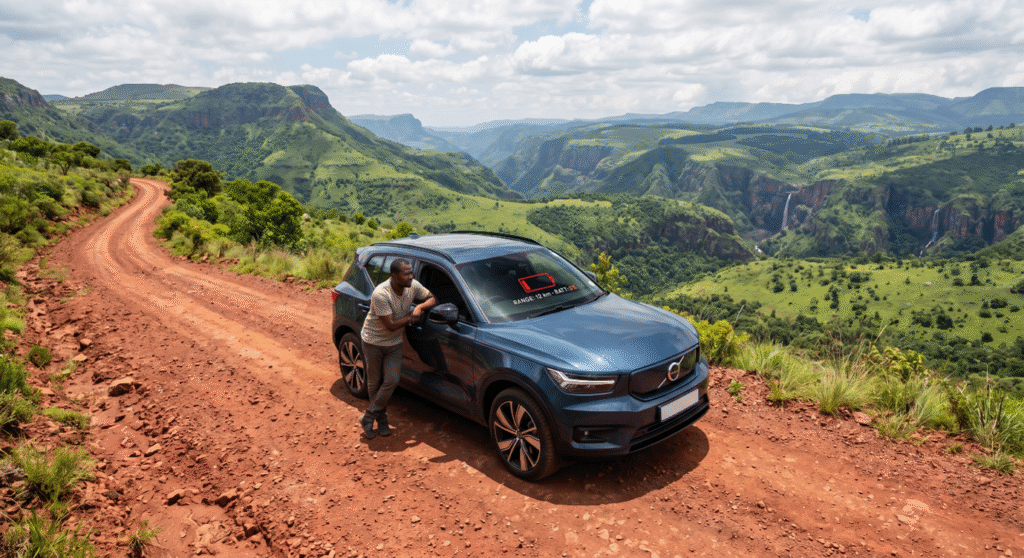
The honest starting point is that battery-electric vehicles barely exist in this market. Naamsa recorded 1 088 fully electric passenger cars sold in 2025 – about 0.2% of a total new-vehicle market of just under 600 000 units. Even that figure needs a footnote, because BYD, Geely and Dongfeng did not report their sales to Naamsa for most of the year, so the true number is somewhat higher. Around it, though, the ground is shifting quickly. Plug-in hybrid sales grew 280% in a single year. The broader new-energy segment reached 16 716 units. AutoTrader reported a 220% increase in EV searches between March 2025 and March 2026, and in April this year the BYD Dolphin Surf sold 302 units – the top-selling EV in the country, outselling petrol hatchbacks like the Honda Fit and Kia Picanto. Something structural is moving. The question is whether it has moved far enough for a rational buyer – not an enthusiast, not an early adopter, a person who owns a calculator – to sign.
The network is thinner than the map suggests
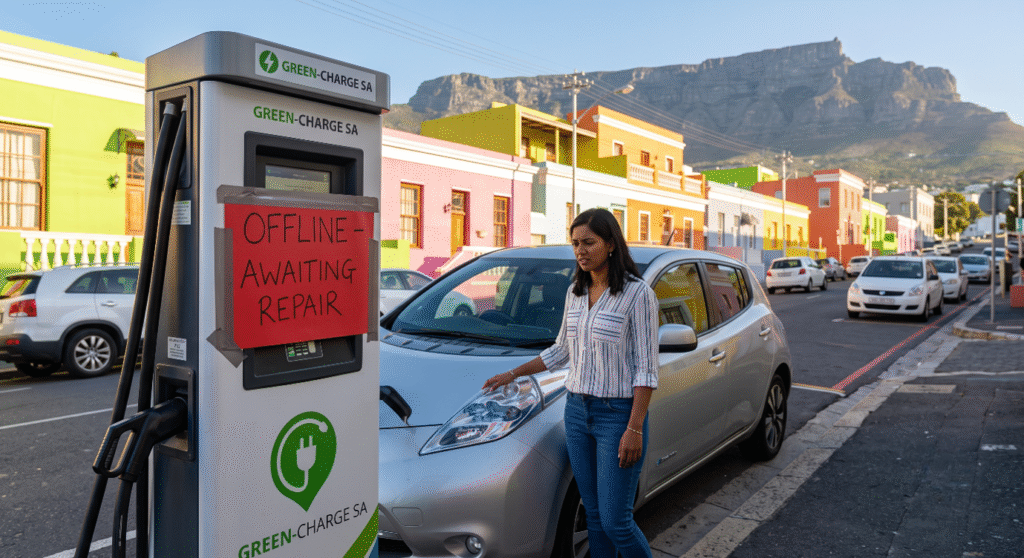
South Africa has 650 public chargers spread across some 445 sites, with more than 1 200 individual connectors. GridCars operates around 60% of that capacity, with Rubicon, CHARGE and Zero Carbon Charge accounting for most of the rest. Gauteng and the Western Cape between them hold close to 80% of the country’s public charging points, which is a polite way of saying the other seven provinces share the scraps. In the metros, coverage is genuinely workable. Beyond them, it changes fast: the N1 through the central Karoo still carries charging gaps measured in hundreds of kilometres, the N2 between East London and Durban is sparse, and the Free State interior and Limpopo beyond Polokwane are, for practical purposes, petrol country.
The economics explain the gaps. GridCars’ own leadership has said publicly that public charging has no viable business case yet, and that the country needs something like 100 000 EVs on the road before operators turn a real profit. We have perhaps 4 500. Nobody builds filling stations for 4 500 cars.
Two things soften the picture considerably. The first is that public charging is the exception, not the rule. Industry surveys put 90–95% of South African EV charging at home, at residential rates of R2.00–R3.40 per kWh, against public DC rates of R7.00–R7.35 – and up to R11.76 at some branded sites. The real infrastructure question is not how many chargers the country has. It is whether you have off-street parking and a wall to mount a charger on. The second is that long-distance charging is improving in exactly the right places. The Development Bank of Southern Africa has backed two fully off-grid, solar-powered charging stations on the N3 between Johannesburg and Durban with a R100 million investment; at the Tugela site, a Volvo ES90 recently charged from 9% to 79% in 20 minutes at a peak rate of just under 322 kW. That is a proper road-trip stop, not a mall wall box. There are simply not enough of them yet.
Range stopped being the problem. Price was.
In 2022, the cheapest electric car in South Africa was the Mini Cooper SE at R709 400. Today it is the Geely E2 at R339 900, with the BYD Dolphin Surf at R341 900 a whisker behind. The entry price of electric motoring has halved in four years, in nominal rands, over a period in which everything else got more expensive. That is the single most important number in this piece.
What R340 000 buys is honest but modest. The E2 claims 325 km from a 39.4 kWh battery; the Dolphin Surf offers 232 km in base trim and 295 km with the larger pack. Move up the price list and the claims climb: the BYD Atto 3 is rated around 420 km, the Volvo EX30 and BMW iX3 sit broadly in the 400–460 km band, and several models now claim 500 km or more. Treat every one of these figures the way you treat a fuel-consumption brochure: real-world testing consistently returns 10–20% less than claimed, and worse at 120 km/h into a Karoo headwind with the air conditioning running. My working assumption is to knock a fifth off the sticker and plan on the remainder.
For the way most South Africans use a car, that is already enough. A 50 km daily commute drains even an entry-level EV only every four or five days, and it refills overnight in a garage. For the December run to the coast, it means two or three planned stops and total dependence on a thin national corridor. The importers understand this geography better than the purists do, which is why range-extended electrics – the Changan Hunter double-cab bakkie and the Leapmotor C10, with small petrol generators feeding the battery – now claim over 900 km and are selling on precisely that reassurance.
The quiet revolution is in the battery
Five years of battery progress is the reason the entry price halved. BloombergNEF’s annual survey put the average lithium-ion pack at $108 per kWh in 2025 – down 8% on the year, and 93% below 2010 levels – after a fall of around 20% in 2024. Packs destined for battery-electric vehicles averaged $99 per kWh, the second consecutive year under the symbolic $100 line. The chemistry doing the work is lithium iron phosphate, or LFP: no cobalt, no nickel, materially cheaper, far more tolerant of repeated charging, and by 2025 accounting for over 55% of EV batteries deployed worldwide. The BYD “blade” pack in the cheapest cars on our market is exactly this technology.
Durability has followed the same curve. Independent battery-health data suggests modern packs degrade at 1–2% a year, and only about 1% of EVs built after 2016 have needed a battery replacement. The market has priced that confidence into its promises: even the R341 900 Dolphin Surf carries an eight-year/200 000 km battery warranty. Charging speed, the other historical complaint, is yielding to engineering – that 20-minute Tugela charge would have read as science fiction in 2021, and sodium-ion cells with 15-minute charge times have already been certified in China for market entry this year.
There is a sting buried in all this progress, and it belongs two sections down: when the product improves this quickly, the one you bought last year ages just as quickly.
The money
Running costs are where the electric case is close to unanswerable. A typical EV uses 15–18 kWh per 100 km. At home tariffs, this works out to R37–R60 per 100 km. A petrol car averaging 9 litres per 100 km, with 95 unleaded at R23.36 a litre, costs about R210 over the same distance. Maintenance runs 30–40% lower – no oil changes, no spark plugs, and regenerative braking that makes brake pads a rare purchase. Fleet operators who have done the sums at scale, such as Everlectric, report total cost of ownership below the petrol equivalent despite the higher purchase price. Their fleets are the closest thing this market has to a controlled experiment, and the experiment favours the battery.
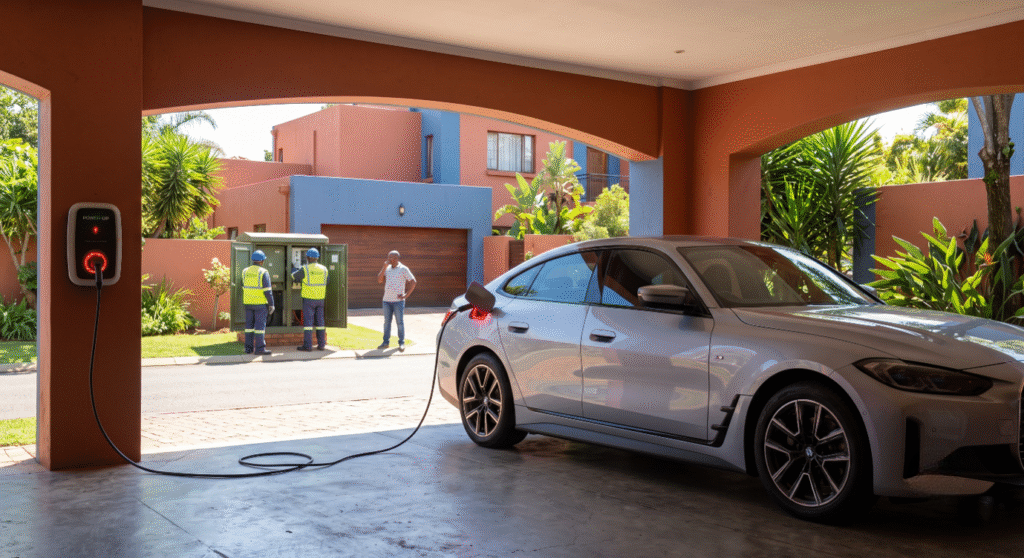
The purchase price is where policy fights the buyer. Imported EVs attract a 25% duty, while combustion vehicles imported from Europe pay 18%; an ad valorem tax that can reach 30% stacks on top, and since 2025 a 15% duty applies to imported EV batteries. Consumer purchase incentives do not exist – none. The much-publicised 150% tax deduction that took effect in March this year rewards manufacturers investing in local production; it puts nothing in a buyer’s pocket. Insurance typically prices 10–15% above the petrol equivalent, partly offset by green-vehicle discounts at some insurers. And the home wall box that makes the whole proposition work costs R8 000–R25 000 installed. The running-cost arithmetic is compelling. The admission fee is punitive, and deliberately so.
Resale – the number nobody prints in the brochure
Now the uncomfortable part. Depreciation is the largest single cost of owning any car, and on the evidence available, EVs in South Africa depreciate worse than anything else on the road. AutoTrader’s analysis cites research showing the average EV losing close to half its value over five years, against roughly 39% across all vehicle types. The local data from 2024 was uglier at the top end: a review of AutoTrader listings found the Mercedes-Benz EQS heading the depreciation table, with the Jaguar I-Pace losing just under R35 000 a month and the Audi e-tron around R34 500. A handful of models held up remarkably well – the Volvo XC40 Recharge and BMW iX1 barely moved – but the pattern is unmistakable: the bigger the badge and the price, the harder the fall.
The mechanism matters more than the numbers. Every time a manufacturer cuts the price of a new EV or launches a better one – which in this market happens monthly – every used example on the classifieds gets marked down to match. The buyer who paid R709 400 for the country’s cheapest EV in 2022 now competes against a brand-new car at R339 900 with a longer warranty. The price war that makes 2026 the best year yet to buy an electric car is, from the other side of the ledger, a wealth transfer from everyone who bought one earlier. It will keep working that way until the technology curve flattens.
Two genuine consolations. A used-EV market is finally forming: AutoTrader’s mid-year report showed used battery-electric sales up 65% year on year in the first half of 2025, led by the Volvo EX30 and XC40. And battery-health verification is becoming standard, which strips out the used buyer’s biggest fear. The depreciation gap should narrow as the market matures. Buy today on the assumption that it has not.
Where the petrol case still wins
I would be writing fiction if I stopped there. The combustion argument remains strong in specific, common South African circumstances. If yours is a one-car household doing regular long-distance mileage, the charging corridor is too thin and the December queue risk too real. If you tow – a caravan, a boat, a trailer of any weight – expect range to fall 40–60%, which turns a 400 km car into a 180 km car. If you live or travel rurally, or head across our northern borders, there is nothing to plug into; a twenty-year-old diesel can be repaired in any town in the country, and an EV cannot. If you cannot charge where you sleep, the running-cost case collapses to about half its strength at public rates. And if you trade cars every three years, re-read the resale section – it was written for you. The duty regime, meanwhile, remains actively hostile to the EV buyer, and I see no evidence it will change before export pressure forces it to.
The verdict
So, to my colleague’s question. Buy an electric car in 2026 if you are a two-car urban household with off-street parking – better still with solar on the roof; if the car will do a predictable daily commute; and if you intend keeping it seven years or longer, riding out the depreciation while banking a running-cost saving in the region of R15 000 per 10 000 km against a petrol equivalent. Buy one if you operate a fleet with a depot, because the operators have already proven that case with their own money. Do not buy one as your only car if a meaningful share of your mileage runs between provinces. Do not buy one to tow. Do not buy one if you cannot charge at home. And do not buy a premium EV expecting it to hold its value, because the evidence says plainly that it will not.
The quote on my colleague’s phone expired unsigned. He had been pricing the wrong car. The real question was never electric versus petrol; it was which car in the household the battery should replace. A week later he re-quoted – this time against his wife’s 60 km commute rather than his own N1 mileage – and signed the same afternoon. The diesel stays in the garage for December. On the numbers as they stand in the middle of 2026, both of those decisions were correct.
Johan de Villiers
CEO First Technology Western Cape
