

Director’s View
By Johan de Villiers

Welcome to our latest quarterly newsletter. In this edition, I’ve been exploring a fascinating corner of finance that has quietly been reshaping how we understand the future: prediction markets. You may have come across the name Kalshi during the 2024 US elections, or perhaps stumbled onto it through a news headline about people betting on interest rates or even the weather. It turns out, the idea of putting real money behind your beliefs about the future is far older than you might think – and far more consequential.
Wagering on What’s Next
The concept of prediction markets isn’t new. There is evidence from sixteenth-century Italy of insurance-like arrangements tied to papal succession. In eighteenth-century Britain and nineteenth-century America, people placed wagers on presidential elections and other major events in much the same way we bet on horse races today. These early markets thrived because they tapped into something powerful: when people put their own money on the line, they tend to be brutally honest about what they think will happen, regardless of what they want to happen. It’s a simple but profound insight – financial incentive strips away wishful thinking and forces a kind of intellectual honesty that opinion polls simply cannot replicate.
The modern revival of this idea began in 1988 with the Iowa Electronic Markets, an academic experiment run by the University of Iowa. It allowed small-stakes trading on political outcomes and quickly demonstrated something remarkable – these markets consistently outperformed traditional opinion polls in forecasting election results. The logic was elegant: a market aggregates the knowledge, intuition, and private information of thousands of participants into a single price. It is, in essence, the wisdom of the crowd with financial teeth. Researchers found that the Iowa markets were particularly effective because they responded in real time to new information, unlike polls, which are static snapshots of past sentiment.
Enter Kalshi: Building a New Asset Class
Fast forward to 2018, when two MIT graduates, Tarek Mansour and Luana Lopes Lara, decided that prediction markets deserved to move out of academic labs and into the mainstream. Both had backgrounds in quantitative finance at firms like Goldman Sachs, Citadel, and Bridgewater, and they’d noticed something odd: trillions of dollars in financial decisions were driven by predictions about future events, yet there was no simple, direct way to trade on those outcomes. Existing financial products relied on complex structures to approximate event exposure, which were often cumbersome and expensive. So they set about building something better.
What made Kalshi different from the start was its obsession with regulatory legitimacy. Rather than operating offshore or in a legal grey zone – as many crypto-based competitors chose to do – the founders spent years and reportedly more than $30 million in legal fees pursuing full compliance. In 2020, the Commodity Futures Trading Commission (CFTC) designated Kalshi as an authorised contract market, placing it alongside institutional heavyweights like the Chicago Mercantile Exchange and the Intercontinental Exchange. It was a historic first: the only federally regulated exchange in US history built specifically for event contracts. The company went on to attract investment from prominent backers including Sequoia Capital, Y Combinator, and notable figures such as Charles Schwab and Henry Kravis.
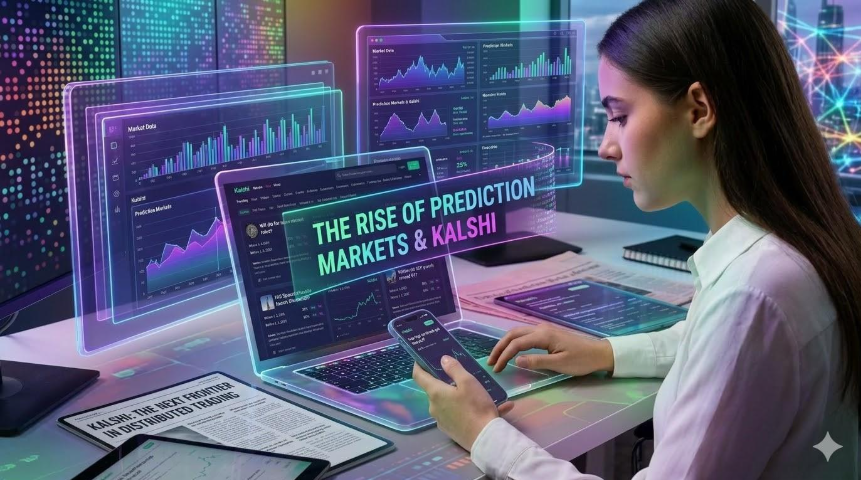
How It Actually Works
The mechanics are surprisingly simple. Every market on Kalshi is structured as a binary question with a defined resolution date. “Will the Federal Reserve cut interest rates in June?” “Will the average temperature in Chicago exceed 30°C this Thursday?” “Will film X win the Oscar for Best Picture?” You buy a “Yes” or “No” contract, priced between one cent and ninety-nine cents. That price reflects the market’s collective estimate of the probability. If you buy a “Yes” contract at 30 cents and the event occurs, you receive a dollar. If it doesn’t, you lose your 30 cents. It is, at its core, a way to translate conviction into a financial position.
The range of tradeable events is staggering: economic indicators like GDP and unemployment figures, election outcomes, weather events, sports championships, and even cultural moments. By late 2025, Kalshi had processed tens of billions of dollars in trading volume, reached an $11 billion valuation, and integrated with Robinhood to reach millions of retail investors. CNN and CNBC became broadcast partners, displaying Kalshi’s market-implied probabilities alongside traditional polling data during live broadcasts. The co-founder, Luana Lopes Lara, became the youngest self-made female billionaire – a remarkable achievement that underscored just how quickly this new asset class had captured public attention.
Kalshi isn’t alone in this space, of course. PredictIt, a New Zealand-based platform operated by Victoria University of Wellington, has offered political prediction markets since 2014, albeit with a more academic flavour and a $3,500 cap on individual contract volume. Polymarket, a cryptocurrency-based platform founded in 2020, operates globally using blockchain technology. But Kalshi’s regulated status in the US gives it a unique competitive advantage and a level of institutional trust that its rivals have struggled to match.
The Promise and the Peril
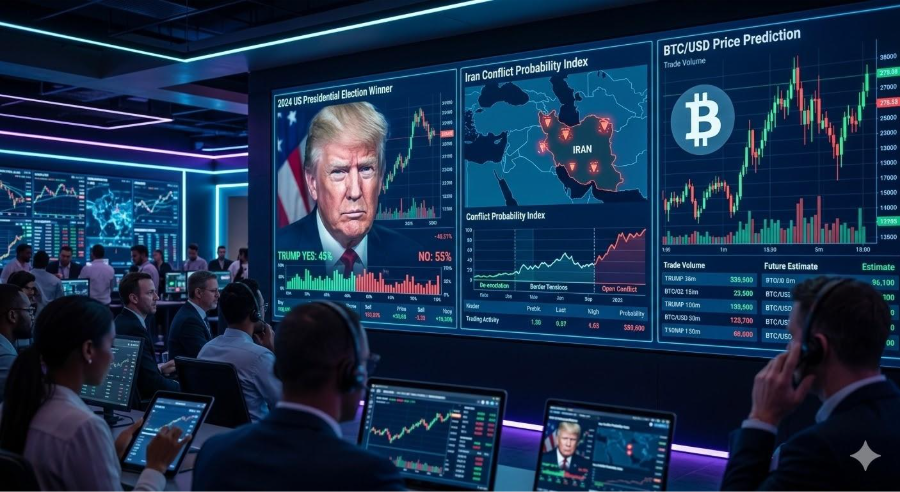
Proponents argue that prediction markets represent a leap forward in how society processes information. When your money is at stake, you have a powerful incentive to seek out the truth rather than simply echo your preferred narrative. During the 2024 US presidential election, prediction markets attracted over $2.4 billion in transactions across platforms like Kalshi, Polymarket, PredictIt, and the Iowa Electronic Markets. By several measures, the markets came closer to the final Electoral College tally than most traditional polls. As one Northwestern University data scientist put it, prediction markets don’t ask people to give an opinion; they ask people to put their money down – and when you put your money down, you tend to believe what you’re betting on, whether you like the outcome or not.
But the picture is far from spotless. Academic research analysing those same 2024 election markets found significant inefficiencies: prices for identical contracts diverged wildly across platforms, daily price changes were weakly correlated, and arbitrage opportunities actually peaked in the final two weeks before Election Day – precisely when markets should have been at their most efficient. While PredictIt correctly predicted outcomes better than chance in 93% of its markets, accuracy fell to 78% on Kalshi and 67% on Polymarket. Critics have also raised serious concerns about market manipulation, pointing to incidents like the so-called “French Whale” on Polymarket whose enormous bets appeared designed to shift public perception rather than reflect genuine forecasting.
There are uncomfortable ethical questions too. Kalshi has faced backlash for allowing wagers on sensitive geopolitical events, and in early 2026 a class action lawsuit was filed alleging that the platform operated unlicensed sports betting and led users to unknowingly bet against Kalshi or its partners rather than against other users. The gaming industry has poured significant resources into lobbying efforts targeting what it sees as a prediction markets loophole. These are not trivial concerns, and they speak to the broader tension between financial innovation and the need for responsible oversight.
What It Means for the Rest of Us
Whether prediction markets ultimately prove to be a revolutionary tool for collective intelligence or just another speculative playground remains to be seen. The truth, as usual, probably lies somewhere in the middle. At their best, these markets offer a genuinely useful signal – a real-time, financially incentivised measure of what informed participants believe is likely to happen. Companies have already begun using internal prediction markets to gauge the likelihood of product launches and strategic outcomes, finding that employees are more honest when their forecasts carry financial consequences. At their worst, prediction markets risk trivialising serious events and attracting the same speculative excesses that plague every financial innovation.
What’s undeniable is that the genie is out of the bottle. With regulatory approval secured, major platform integrations in place, and a generation of digitally native investors hungry for new instruments, prediction markets are here to stay. Kalshi is already expanding categories, onboarding major liquidity providers, and exploring blockchain tokenisation of its markets using the Solana network. The challenge for regulators, participants, and observers alike is to ensure that this powerful new tool serves the cause of better information – not just faster gambling. Watch this space, because the market, quite literally, is betting on it.
Ending off, please take a look at our new Podcast series, JDV on Air!

Listen now on your favourite platform:
• Spotify – https://open.spotify.com/show/6MXc0yroB203IBZ1vYFZHD
• Apple Podcasts – https://podcasts.apple.com/us/podcast/jdv-on-air/id1837452562
• YouTube – https://www.youtube.com/@JDVONAIR
• Website – https://onair.johandevilliers.com/
Warm Regards,
Johan de Villiers
CEO
First Technology Western Cape
